Thursday, January 15, 2026

Whither Bostock?

Courtly Observations is a recurring series by Erwin Chemerinsky that focuses on what the Supreme Court’s decisions will mean for the law, for lawyers and lower courts, and for people’s lives.

What will be the fate of Bostock v. Clayton County, Georgia, the Supreme Court’s 2020 landmark ruling protecting gay, lesbian, and transgender individuals from employment discrimination? Over the last year, the court has failed to follow the logic of Bostock in upholding discrimination against transgender individuals. And at the oral arguments on Jan. 13, in two cases involving state laws barring transgender girls and women from participating in sports that correspond to their gender identity, the oral arguments gave the strong sense that a majority of the justices are likely to uphold the state laws, making even more salient the question of what will be left of Bostock.

Bostock v. Clayton County, Georgia

In Bostock, the Supreme Court ruled, 6-3, that Title VII’s prohibition of employment discrimination “because of sex” protects gay, lesbian, and transgender individuals. Justice Neil Gorsuch wrote for the court, joined by Chief Justice John Roberts and Justices Ruth Bader Ginsburg, Stephen Breyer, Sonia Sotomayor, and Elena Kagan.

Actually, there were three cases before the court, although all were decided in one opinion. Bostock and Altitude Express v. Zarda involved men who were fired for being gay. R.G. & G.R. Harris Funeral Homes Inc. v. Equal Employment Opportunity Commission involved Aimee Stephens, a funeral home director, who was fired for being a transgender woman.

The court’s holding was clear and emphatic. It declared: “In Title VII, Congress adopted broad language making it illegal for an employer to rely on an employee’s sex when deciding to fire that employee.  We do not hesitate to recognize a necessary consequence of that legislative choice: An employer who fires an employee merely for being gay or transgender defies the law.”

Gorsuch’s majority opinion stressed the plain meaning of the prohibition of discrimination “because of sex” in Title VII. A simple example illustrates the basis for this conclusion. Imagine an employee named Chris. Chris and the employer communicate by text and email but never have met in person or talked by phone. Chris often has referred to a husband in discussing evening or weekend plans. When Chris and the employer meet, the employer is surprised that Chris is male. The employer fires Chris, saying that he does not want to employ gay people. If Chris were female, Chris would still have the job. That, by definition, is employment discrimination because of sex. 

Likewise, the court’s reasoning in ruling in favor of Aimee Stephens was that Stephens would have continued to have the position as a funeral director at Harris Funeral Homes if Stevens were male, but she lost the job for presenting as female. That, too, is employment discrimination because of sex.

Although Bostock was about interpreting Title VII, its reasoning has much broader implications. The court concluded that “[i]t is impossible to discriminate against a person for being homosexual or transgender without discriminating against that individual based on sex.”  This should apply to other federal statutes – and there are over 100 – that prohibit sex discrimination. 

This reasoning also has implications under the equal protection clause of the Fourteenth Amendment. Specifically, if discrimination based on sexual orientation and gender identity are seen as forms of sex discrimination, what is called intermediate scrutiny should be applied to such claims. The Supreme Court has used intermediate scrutiny for sex discrimination since 1976. Under this standard, a law that discriminates against a particular group can only be upheld if it is substantially related to an important government purpose.

The failure to follow Bostock

In 2025, the Supreme Court decided three cases – one on the merits docket and two on the emergency docket – that involved discrimination against transgender individuals. In each, the court, by a 6-3 margin, ruled in favor of the government and allowed for the discrimination.

In United States v. Skrmetti, the court upheld a Tennessee law that prohibited gender affirming care for transgender youth. Roberts’ majority opinion said that the law was not sex discrimination because it prohibited gender affirming care for both boys and girls. And the court said that was not discrimination based on gender identity because both cisgender and transgender individuals could use drugs such as puberty blockers for some purposes; they were prohibited only for the purpose of gender transition. The court did not reach the issue of the level of scrutiny to be used for gender-identity discrimination, although Justices Clarence Thomas, Samuel Alito, and Amy Coney Barrett wrote concurring opinions arguing that only rational basis review should be used (in which the court gives great deference to the state).

The court’s opinion said that Bostock was irrelevant and declared: “We have not yet considered whether Bostock’s reasoning reaches beyond the Title VII context, and we need not do so here.” This was because the court said that the law would prohibit administration of hormones for gender transition regardless of the sex or gender identity of the individual.

Sotomayor, writing for the three dissenters, strongly disagreed and said that the Tennessee law was entirely about denying care to transgender individuals and that under Bostock this was discrimination both based on sex and on gender identity. She wrote that the Tennessee law “discriminates on the basis of transgender status is yet another reason it must be subject to heightened scrutiny.  For one, this Court already decided in Bostock that ‘it is impossible to discriminate against a person for being . . . transgender without discriminating against the individual based on sex,’ and sex discrimination is of course subjected to heightened scrutiny.”

Additionally, in two cases on the emergency docket, the court without opinion stayed preliminary injunctions by lower courts that prevented the Trump administration from discriminating based on gender identity. In United States v. Shilling, the court allowed the Trump administration to bar transgender individuals from military service. In Trump v. Orr, the court allowed the State Department to require that a person’s passport state that individual’s sex assigned at birth.

Laws barring transgender girls and women from competing in sports

In the cases heard on Jan. 13, the six conservative justices seem strongly inclined to uphold state laws that prevent transgender girls and women from participating in sports that correspond to their gender identity. Little v. Hecox involves Lindsay Hecox, a 24 year-old transgender woman who wanted to try out for the women’s track and cross-country teams at Boise State University. Idaho’s Fairness in Women’s Sports Act prohibits transgender women and girls from participating in women’s and girls’ sports in public K-12 schools and universities, requiring teams to be designated by biological sex (male, female, co-ed). Hecox challenged the law and the federal court of appeals ruled in her favor, although she now urges the Supreme Court to dismiss the case as moot because she no longer wishes to compete and will not in the future.

West Virginia v. B.P.J. involves a challenge to a West Virginia law, the Save Women’s Sports Act, which bars transgender women and girls from participating on women’s and girls’ sports team in public secondary schools and colleges. The challenger is a 15 year-old transgender girl who wanted to participate in sports in middle school. B.P.J. has publicly identified as female since the third grade, takes medicine to stave off the onset of male puberty, and has also begun to receive hormone therapy with estrogen. The federal court of appeals also ruled in favor of her.

Bostock should be crucial in both cases. Idaho, echoing President Donald Trump, argues in its brief that there are two sexes, male and female, determined by what is assigned at birth and reproductive organs. But Bostock implicitly rejects this in recognizing gender identity and holding that discrimination based on it is sex discrimination. 

One of the issues in West Virginia v. B.P.J. is whether the state’s law violates Title IX of the Civil Rights Act, which prohibits educational institutions receiving federal funds from discriminating “on the basis of sex.” West Virginia’s brief distinguishes Bostock by declaring, “Title VII ‘is a vastly different statute’ from Title IX,’” pointing to the difference in the wording of the laws. But the actual statutory language belies this assertion. Title VII prohibits discrimination in “employment practice[s]” “because of” sex. Title IX prohibits discrimination “under any education program” “on the basis of sex.”  

A great deal of time was spent at the oral arguments on what does “sex” mean. Bostock, though, answers this question for Title VII in expressly holding that “sex” includes sexual orientation and gender identity, and there is no reason this is any different for Title IX. If the court follows Bostock, laws prohibiting transgender athletes from competing are also sex discrimination in violation of Title IX.

There is also the constitutional question of whether barring transgender athletes is sex discrimination, requiring that the governments meet intermediate scrutiny. The reasoning of Bostock again answers this question. The only reason that these transgender individuals cannot compete is because of their sex. Of course, under equal protection analysis, there is the separate question of whether the government can justify its discrimination, proving that it is substantially related to an important government purpose. The states argue that their laws are necessary to protect women’s and girls’ sports. But that is a factual question for the district courts, not one for the Supreme Court to decide. And in Hecox, the district court said that there is a “dearth of evidence in the record to show excluding transgender women from women’s sports supports sex equality, provides opportunities for women, or increases access to college scholarships.”

Conclusion

Little v. Hecox and West Virginia v. B.P.J. will be important in deciding the legality of state laws barring transgender girls and women from competing in sports. But they also will have even larger significance in indicating whether the court will follow, or abandon, its landmark ruling in Bostock, one of the most important decisions in history protecting gay, lesbian, and transgender individuals from discrimination.

The post Whither Bostock? appeared first on SCOTUSblog.

https://www.scotusblog.com/2026/01/whither-bostock/ January 15, 2026 at 09:30AM

Court holds that all candidates can challenge rules governing vote counting in elections

In a surprisingly sweeping opinion issued Wednesday, a five-justice majority in Bost v. Illinois State Board of Elections held that a federal congressional candidate had a legal right to sue, known as standing, in federal court to challenge an Illinois law that allows mail-in ballots postmarked by Election Day to be counted as many as 14 days later. Reversing lower federal court rulings that denied Rep. Michael Bost (R-Ill.) standing to sue, the majority opinion by Chief Justice John Roberts adopted a categorical rule upholding candidate standing based on a candidate’s inherent interest in “the integrity of the election” and the “democratic process.” 

The vote was 7-2 in favor of Bost, with Justice Amy Coney Barrett, joined by Justice Elena Kagan, agreeing with the result that the majority reached but not its reasoning. Justice Ketanji Brown Jackson, joined in dissent by Justice Sonia Sotomayor, would have affirmed the lower courts’ denial of standing.

Under the “case or controversy” clause of Article III of the Constitution, plaintiffs in federal court only have standing to sue if they properly allege that the challenged action or law causes them “concrete and particularized injury in fact.” The Supreme Court has generally interpreted that rule to deny standing based merely on some category that the plaintiff falls into, such as “citizen standing” or “taxpayer standing.” Instead, the court has usually required plaintiffs to allege that that they have suffered some kind of judicially cognizable real-world harm that sets them apart from the broad run of society. 

Adopting the principal argument advanced by Bost, the majority stated, “Candidates have a concrete and particularized interest in the rules that govern the counting of votes in their elections, regardless whether those rules harm their electoral prospects or increase the cost of their campaigns.” That candidate interest in protecting the integrity and fairness of the electoral process “is in no sense ‘common to all members of the public,’” Roberts asserted. Although the public also has an interest in the integrity of elections, the candidate’s interest “differs in kind.”  An unfair election “plainly affects those who compete for the support of the people in a different way than it affects the people who lend their support,” Roberts stated.

The eventual triumph of Bost’s categorical candidate standing argument was surprising because none of the justices at oral argument had openly agreed; indeed, Kagan confidently declared that it could not be correct. “It’s not enough just to walk in and say: Hi, I’m a candidate and I’m suing,” she said at argument. Instead, she said, the candidate must show some kind of substantial risk that the new (challenged) rule would put the candidate at some kind of disadvantage vis-à-vis the old rule. 

Justice Neil Gorsuch then pointedly asked former U.S. Solicitor General Paul Clement, who represented Bost, whether Bost could satisfy the more specific standard that Kagan had just articulated, creating the impression that Gorsuch agreed with it. But Gorsuch ended up voting for the majority’s categorical rule.

The majority may have been influenced by remedial concerns similar to those voiced by Justice Brett Kavanaugh during oral argument. There, Kavanaugh had remarked that an undesirable effect of denying candidates standing to challenge vote-counting rules before Election Day would put courts on the spot afterward, when someone already appeared to have won and others to have lost. 

In his opinion for the court, Roberts criticized the dissent’s argument that candidates should not be deemed to have standing unless they properly alleged that the challenged rule likely made the difference between winning and losing. The problem, he said, is that a court probably can’t tell whether a rule affected the ultimate result until after the votes are counted pursuant to that rule. Roberts quoted from an opinion written by the late Justice Antonin Scalia while concurring in the grant of a stay during Bush v. Gore in 2000: “Count first, and rule upon legality afterwards, is not a recipe for producing election results that have the public acceptance democratic stability requires.”

In her concurring opinion in Bost, Barrett articulated a middle position between the majority’s rule that all candidates automatically have standing to challenge vote-counting procedures and the dissent’s proposed rule that candidates should have to demonstrate a likelihood that the challenged procedure would make the difference between winning and losing. Barrett, who was a prominent scholar of Article III as a law professor, would have held for Bost on the ground that he suffered a “pocketbook injury” from having to spend more money on poll observers and other campaign staff because of the additional 14 days following the close of the polls.

“Pocketbook harm is a traditional Article III injury,” Barrett stated. “That is so not only when a law directly imposes costs on a plaintiff, but also when a plaintiff ‘reasonably incurs costs to mitigate or avoid’ the ‘substantial risk’ of a harm caused by a statute,” she noted. Barrett criticized the majority’s approach as an unnecessary departure from the court’s usual insistence upon specificity and concreteness in an Article III injury analysis. “By holding that a candidate always has an interest in challenging vote-counting rules, even if those rules do not impose a competitive disadvantage on him, the Court today relieves candidates from having to show any real harm.” Why should elections be treated differently from everything else for purposes of standing analysis? she asked. “Elections are important,” Barrett wrote, “but so are many things in life. We have always held candidates to the same standards as any other litigant.”

In her dissent, Jackson echoed Barrett’s characterization of the majority opinion as a departure from past practice treating candidates like other litigants. Going further, she argued that the majority’s new category of candidate standing could not be meaningfully distinguished from the claims of “citizen” and “taxpayer” standing that the court has almost always rejected. “Anyone and everyone who is governed by law is similarly harmed by any departure from the law’s requirements,” Jackson stated. “[T]his Court has repeatedly instructed that litigants ‘may not sue based only on an asserted right to have the Government act in accordance with law.’”

The post Court holds that all candidates can challenge rules governing vote counting in elections appeared first on SCOTUSblog.

https://www.scotusblog.com/2026/01/court-holds-that-all-candidates-can-challenge-rules-governing-vote-counting-in-elections/ January 15, 2026 at 08:30AM

SCOTUStoday for Thursday, January 15

Hat tip to The Hill for noticing that Justice Neil Gorsuch is apparently a jokester not just during oral arguments, but also in written opinions. In his dissent in Bowe v. United States, Gorsuch described Loper Bright Enterprises v. Raimondo, a major case in which the court overturned the Chevron doctrine, as an “obscure administrative law case.” SCOTUS humor, I know…

Latest Opinions

Wednesday morning, the court released its opinions in three argued cases: Bost v. Illinois State Board of Elections, Case v. Montana, and Barrett v. United States.

  • In Bost, the court held that, as a candidate for office, Congressman Michael Bost has standing to challenge Illinois’ rules for counting mail-in ballots received after Election Day.
  • In Case, the court held that police officers in Montana did not violate the Fourth Amendment when they entered a home without a warrant and without “probable cause” because they reasonably believed that someone in the house needed emergency assistance.
  • In Barrett, the court held that defendants who violate two separate provisions of the Armed Career Criminal Act cannot be convicted under both for the same crime.

SCOTUS Quick Hits

  • The court has not yet indicated when it will next release opinions.
  • Also on Wednesday, the justices heard argument in Galette v. New Jersey Transit Corporation, on whether New Jersey Transit Corporation is an “arm of the state” that can invoke sovereign immunity to prevent suits against it in other states. For more on the argument, see the On Site section below.
  • Tomorrow, the justices will take part in a private conference to discuss cases and vote on petitions for review. We may know as soon as that afternoon if the court has added any new cases to the oral argument docket.
  • On Wednesday, Jan. 21, we will be live blogging as the court hears oral argument in Trump v. Cook, on President Donald Trump’s effort to remove Lisa Cook as a member of the Federal Reserve Board of Governors.

Morning Reads

  • Parents Ask Supreme Court to Restore Ruling on Gender Disclosure (Mark Walsh, Education Week) — A group of California parents has asked the Supreme Court to intervene after the U.S. Court of Appeals for the 9th Circuit blocked “a federal district court decision that said parents have a federal constitutional right to be informed by schools of any gender nonconformity and social transition by their children,” according to Education Week. The 9th Circuit panel said that the district court’s decision was “too ‘sweeping’ and ‘ambiguous’ and likely wrong on the merits,” and the panel “reinstated a mandate by the California Department of Education that restrains teachers and district staff members from informing parents about a child’s gender identity at school, unless the child consents.”
  • Louisiana Indicts Another Out-of-State Doctor Over Abortion Pills (Emily Cochrane and Pam Belluck, The New York Times)(Paywall) — As part of their broader push to limit abortion in the state, “Louisiana officials on Tuesday moved to extradite a California doctor the state indicted on a charge of providing abortion pills to a Louisiana resident,” according to The New York Times. Cases like these over abortion pill prescriptions are part of a new wave of legal battles over abortion that emerged after “the U.S. Supreme Court eliminated the national right to abortion in 2022.” Legal experts expect that the court may soon need to address “whether states are required to honor one another’s abortion laws.”
  • ‘When did I do that?’ Trump says about $2,000 tariff dividend checks (Mike Snider, USA Today) — During a recent interview with The New York Times, President Donald Trump appeared surprised to be asked about his previous comments on sending $2,000 tariff dividend checks to American families, according to USA Today. Since July, Trump has repeatedly pitched sending such checks out by mid-2026, but he now says his administration would need more time than that. “I’ll be able to do $2,000 sometime. I would say toward the end of the year,” the president said. According to the interview transcript, Trump also said that he plans to impose new tariffs through “some other alternative” if the Supreme Court strikes down the current tariffs.
  • No, ICE Agents Do Not Have ‘Absolute Immunity’ From State Prosecution (Damon Root, Reason) — In a column for Reason, Damon Root responded to Vice President J.D. Vance’s recent claim that “the Immigration and Customs Enforcement (ICE) officer who shot and killed Renee Nicole Good in Minneapolis cannot be prosecuted for it by Minnesota officials” because, as a federal law enforcement officer engaged in federal action, he is protected by “absolute immunity.” According to Root, “the precedent is not actually so simple.” In a 1906 case called Drury v. Lewis, the court rejected “a Vance-like argument that called for shielding” officers “from any and all state prosecution,” holding that courts can review disputes “over lawful versus unlawful use of force.”
  • How the Supreme Court May Untangle the Tariff Knot (Dan McLaughlin, National Review)(Paywall) — In a column for the National Review, Dan McLaughlin offered some predictions about the court’s highly anticipated ruling in the tariffs case. He expects the justices to strike down the tariffs but believes “it’s very possible that the Court fractures along multiple lines in saying no.” He also think it’s “unlikely … that the Court will foreclose all future avenues for other Trump assertion of tariff powers, or that it will do much to address how unjustly paid tariffs can be recouped.”

A Closer Look: FBI v. Fazaga

Careful court watchers may recognize the case name FBI v. Fazaga. The justices heard a dispute by that name just over four years ago, which concerned the FBI and three Muslim men who lived and worshipped in Orange County, California.

The men had sued the FBI, alleging religious discrimination and other rights violations, after discovering that agents had paid an informant to gather information on them and their fellow worshippers as part of a counterterrorism operation. The federal government invoked its state-secrets privilege and moved to have the men’s religion claims dismissed, contending that allowing them to go forward would jeopardize national security.

When the Supreme Court got involved during the 2021-22 term, it was to address whether the state-secrets privilege can be trumped by a provision of the Foreign Intelligence Surveillance Act that outlines a way for a district court to review sensitive surveillance information behind closed doors in order to assess the legality of electronic surveillance conducted under FISA without jeopardizing national security. The justices unanimously held that the provision does not displace the privilege and sent the case back to the U.S. Court of Appeals for the 9th Circuit for further proceedings.

After four years, those further proceedings have resulted in an unworkable outcome for the federal government, according to U.S. Solicitor General D. John Sauer, who on Oct. 8 filed a petition for certiorari asking the Supreme Court to reenter the dispute. While the 9th Circuit “determined that the government appropriately invoked the state-secrets privilege,” it went on to adopt “improper and wholly novel procedural requirements that essentially negate the privilege in myriad cases,” Sauer contended.

Specifically, Sauer stated that the 9th Circuit’s new ruling in FBI v. Fazaga requires district courts to review privileged information in order to evaluate the government’s claim to the state-secrets privilege. Such a requirement essentially recreates the situation the federal government previously fought to avoid, Sauer wrote, transplanting the review procedures outlined in FISA to the “state-secrets doctrine itself.”

“That decision,” Sauer continued, “threatens significant and recurring national-security harm.” He urged the justices to either grant the new petition for review and hear arguments on how courts should respond to invocation of the state-secrets privilege or vacate the 9th Circuit’s ruling and remand the case to the district court, where it may be dismissed for other reasons (namely, because the former FBI informant who provided the information about surveillance activities that fueled the Muslim men’s lawsuit has now recanted his story).

In response, the challengers have asked the court to leave the 9th Circuit’s ruling in place, contending, as they have at previous points in the case, that the government’s invocation of the state-secrets privilege is preventing them from making a case that they’re willing to make with the “ample” amount of “non-privileged information” that is now available about the challenged surveillance program. It is appropriate, the men added, for the district court to review the privileged information that the government is trying to protect in order to assess the government’s assertion that it cannot mount a defense without jeopardizing national security.

The court considered the petition in FBI v. Fazaga for the first time during the Jan. 9 conference. It is scheduled to be considered again at tomorrow’s conference.

SCOTUS Quote

“‘Courts sometimes make standing law more complicated than it needs to be.’ Thole v. U.S. Bank N.A., 590 U.S. 538, 547 (2020). We decline respondents’ invitation to do so here.”

— Chief Justice John Roberts, Bost v. Illinois State Board of Elections

On Site

Opinion Analysis

Scaffolding sits around the Supreme Court building in Washington, D.C.

Court finds police properly entered man’s home despite absence of a warrant

The Supreme Court on Wednesday ruled that police officers in Anaconda, Montana, did not violate the Fourth Amendment when they entered a man’s home without a warrant, rejecting the man’s contention that officers needed “probable cause” to enter. It was enough, Justice Elena Kagan wrote for a unanimous court, that officers believed the man needed emergency assistance.

Argument Analysis

U.s.,Supreme,Court,Building,In,Snow,-,Washington,D.c.,United

Justices wrestle with what, exactly, New Jersey Transit is

The Supreme Court on Wednesday debated whether New Jersey’s public transit agency can be sued in state courts in New York and Pennsylvania. The New Jersey Transit Corporation argues that it is an “arm” of the state and, therefore, immune from lawsuits elsewhere, but after a little over an hour of arguments, it was not clear whether a majority of justices agreed.

Contributor Corner

Pulsifer v. US

Presidential rhetoric and Supreme Court nominees

In his latest Empirical SCOTUS column, Adam Feldman discussed how Presidents Barack Obama, Joe Biden, and Donald Trump described Supreme Court justices and potential nominees during their campaigns and in official speeches, reflecting on what these comments told us about their visions for the court.

The post SCOTUStoday for Thursday, January 15 appeared first on SCOTUSblog.

https://www.scotusblog.com/2026/01/scotustoday-for-thursday-january-15/ January 15, 2026 at 08:00AM

Wednesday, January 14, 2026

Justices wrestle with what, exactly, New Jersey Transit is

The Supreme Court on Wednesday debated whether New Jersey’s public transit agency can be sued in state courts in New York and Pennsylvania. The New Jersey Transit Corporation argues that it is an “arm” of the state and therefore is immune from lawsuits elsewhere, but after a little over an hour of arguments, it was not clear whether a majority of the justices agreed.

The lawsuits before the court on Wednesday were filed by men who were injured in accidents with NJ Transit vehicles. Jeffrey Colt went to state court in New York after he was struck by a bus in a crosswalk in Manhattan; Cedric Galette went to state court in Pennsylvania after the car in which he was a passenger was hit by a bus in Philadelphia.

New Jersey Transit, which was created by the New Jersey Legislature more than four decades ago, is one of the largest public transit providers in the United States. Its network of train, bus, and light rail services crisscrosses New Jersey but also extends into New York and Pennsylvania.

Under a doctrine known as interstate sovereign immunity, Colt and Galette would not be able to sue New Jersey itself in New York or Pennsylvania state courts. The Pennsylvania Supreme Court dismissed Galette’s case against NJ Transit, reasoning that the agency is an “arm” of the state and therefore was entitled to the same immunity. The New York Court of Appeals, the state’s highest court, allowed Colt’s lawsuit against New Jersey to go forward, concluding that NJ Transit is not an “arm” of the state.

New Jersey Deputy Solicitor General Michael Zuckerman framed the question before the justices as whether, based on a variety of factors, NJ Transit “is most like a private business, locality, or state agency.” The answer, he suggested, is an easy one: NJ Transit has the power to make rules that will be subject to state procedural laws and to enforce the state’s criminal laws. Moreover, he added, New Jersey’s governor exercises significant control over the board and has the right to veto the board’s actions. “And the state sharply limited NJ Transit’s ability to raise revenue, cut costs, or issue debt, effectively promising to cover its annual deficits as it always has.”

“In short,” Zuckerman concluded, “NJ Transit looks nothing like a city or town and little like a private company. It looks a lot like a New Jersey state agency. That means plaintiffs must sue it where the state has consented, in New Jersey.”

Arguing on behalf of the plaintiffs, lawyer Michael Kimberly urged the justices to focus on the legal status of the public entity seeking immunity as an “arm” of the state. He explained that states have two options when they want to create a new public entity: they can make it part of the state government itself, or they can make it a public corporation. “It is entirely the point of creating a public corporation,” Kimberly emphasized, “that it is a distinct legal person, separate and apart from the state that creates it.” And when a state makes that choice, he stressed, it comes with a downside – “and that’s that” the public corporation “does not share in the state’s sovereign immunity. That has been the consistent holding of this Court for the last 200 years.”

Zuckerman pushed back against any suggestion that New Jersey’s mere designation of NJ Transit as a corporation meant that it could not be an arm of the state. “[W]hen you look at NJ Transit, when you see … how closely tied it is to New Jersey, and you analyze its features, under state law, the word ‘corporation’ … couldn’t have meant that kind of separation because we’re giving it rulemaking power, we’re having it sued in our appellate division the same way you sue every other agency that engages in rulemaking. We have a statewide police department, all of these hallmarks of sovereignty.”

But despite Zuckerman’s efforts to have the court consider the big picture, some justices focused on individual factors, beginning with whether New Jersey can be held liable for NJ Transit’s debts. Chief Justice John Roberts told Zuckerman that “it’s kind of hard to say it’s part of the state if you’re not going to cover it when they get into trouble.” Roberts may have been playing devil’s advocate, however, as he later asked Kimberly whether it was “significant that New Jersey does, in fact, cover the liabilities of the Transit Corporation, regardless of whether it’s a formal commitment which carries with it consequences that I don’t think would be good for either side, but why isn’t that what’s really significant?”

In line with Roberts’ questioning, Zuckerman told the court that even if the state is not formally liable for NJ Transit’s debts, “[w]e fund NJ Transit’s deficits every single year, most years well over $200 million.”

Kimberly offered a different view. “[T]he question of who foots the bill, who ultimately picks up the cost isn’t the relevant question,” he said. “The question … is who bears actual legal responsibility for the judgment.”

Justice Sonia Sotomayor appeared skeptical of Zuckerman’s arguments. The Supreme Court has said, she told him, “that the corporate form itself is evidence that an entity is not the state, correct?” And it has also said, she continued, “that formal liability, not informal liability, not indemnity, but formal liability continues to remain centrally important.” “We’ve called it a critical factor,” she added.  

Justice Ketanji Brown Jackson echoed Kimberly’s arguments, telling Zuckerman that “you’re sort of suggesting that this multifactor look at the function of the entity is … how this was always done and that’s the way it should be done. And I guess I’m questioning,” she said, “I thought originally the idea was is this a corporation? And if it is, it’s sort of presumptively not going to get sovereign immunity.”

Justice Amy Coney Barrett chimed in, also voicing skepticism of any such multifactor test. The Supreme Court, she said, had not “had any cases … in which we have found” that a corporation – like NJ Transit – with the power to bring lawsuits and to be sued “is immune from suit, correct?”

Justice Elena Kagan seemed most sympathetic to New Jersey’s arguments. She invoked the Supreme Court’s 2023 decision in Biden v. Nebraska, striking down the Biden administration’s student-loan debt relief program. In that case, Kagan noted, “the key question was” whether the Missouri Higher Education Loan Authority – one of the country’s largest servicers and holders of student loans – “was a part of Missouri.” MOHELA, Kagan emphasized, was “a sue-and-be-sued agency which had exactly the same kind of insulation from liability as” NJ Transit, and in holding that MOHELA did have standing, she noted, the Supreme Court considered “all the kinds of things that you want us to look at.”

Kimberly responded that the MOHELA issue was just about standing – that is, a legal right to sue at all. “And this Court’s cases,” he said, “recognize that the constitutional status of entities as state actors varies depending on the constitutional context.” In a 1979 Supreme Court case, for example, he said, the justices concluded that the Tahoe Regional Planning Agency – formed by California and Nevada – was a state actor for purposes of a federal civil rights lawsuit against it, but was “not a state entity for sovereign immunity purposes.”

Kagan was unconvinced. “The opinion says MOHELA is a part of Missouri. That’s what allowed the standing to proceed,” she insisted.

Kimberly argued that “the benefit of ruling in our favor … is state lawmakers would have a clear constitutional rule. They would understand … when their entities would be entitled to such immunity and when they wouldn’t.” By contrast, he continued, “[u]nder NJ Transit’s test, it’s sort of a mishmash: You know it when you see it.” “That kind of a rule … really is wholly unworkable and is far, I think, more troubling than anything that a ruling in our favor would implicate.”

In his rebuttal, Zuckerman told the court that in fact NJ Transit’s rule is “far, far simpler and not at all unworkable and I haven’t heard any serious argument [that it] is unworkable to do what this Court has always done, which [is to] say, look there are three buckets … is it a state agency? … is it a municipality or is it a private company? And New Jersey Transit doesn’t look anything like a municipality and it’s true it doesn’t look anything like a private company because no private company could ever have or be subject to the kinds of responsibilities that New Jersey Transit has.”

A decision in the case is expected by the summer.

The post Justices wrestle with what, exactly, New Jersey Transit is appeared first on SCOTUSblog.

https://www.scotusblog.com/2026/01/justices-wrestle-with-what-exactly-new-jersey-transit-is/ January 14, 2026 at 03:27PM

Court finds police properly entered man’s home despite absence of a warrant

The Supreme Court on Wednesday upheld the conviction of a Montana man who was convicted of assaulting a police officer. In a unanimous decision written by Justice Elena Kagan, the court ruled in Case v. Montana that police officers in Anaconda, Montana, did not violate the Fourth Amendment when they entered William Case’s home without a warrant, rejecting Case’s contention that the police officers needed “probable cause” to go into his house. Under the Supreme Court’s earlier cases, Kagan wrote, it was enough that the police officers reasonably believed that Case – whose former girlfriend had called them to tell them that Case had threatened to commit suicide – needed emergency assistance.

The case began in 2021, when Case told his former girlfriend, identified in court papers as J.H., that he “was going to kill himself” and would also shoot any police officers who came to his house. J.H. called 9-1-1, which sent three police officers to the scene for a “welfare check on a suicidal male.”

Although Case did not answer when police officers knocked on the door or yelled into an open window, the police officers saw empty beer cans, an empty handgun holster, and what they believed to be a suicide note in the house. The police officers were also aware that Case had threatened to commit suicide before; on another occasion, police officers believed that Case was trying to goad them into shooting him.

Roughly 40 minutes after they arrived, the police officers entered the home. Case was hiding in a closet in an upstairs bedroom, where he was holding a black object that officers believed was a gun. One officer shot Case in the abdomen; another officer discovered a handgun in a laundry hamper near Case.

Case asked the trial court to exclude the evidence that law enforcement officials obtained after they entered his house, arguing that police officers should have had a warrant. But the state courts rejected that argument, prompting Case to come to the Supreme Court.

Case contended that if police officers enter a home without a warrant to provide emergency assistance, they must have probable cause “to believe someone is in urgent need of help.” On Wednesday the Supreme Court disagreed. In an 11-page opinion, Kagan acknowledged that the sanctity of the home is at the core of the Fourth Amendment, which protects the people from “unreasonable searches and seizures.” As a general rule, she explained, “[w]hen the intru­sion is into that most private place, ‘reasonableness’ usu­ally means having a warrant.” But there are exceptions to that general rule, she continued, including “the need to provide an occupant with emergency aid.”

Two decades ago, in Brigham City v. Stuart, the Supreme Court upheld an entry into a home without a warrant by police officers who were responding to a noise complaint. When they arrived, they saw – through a kitchen window – a fight between a teenager and several adults. The court ruled that the warrantless entry was “reasonable under the circumstances,” Kagan explained, because “[t]he officers had ‘an objectively reasonable basis for believing that an occupant [was] seriously injured or imminently threatened with such injury.’”

The justices, Kagan stressed, “decline[d] Case’s invitation to put a new probable-cause spin onto Brigham City.” The probable-cause standard, she reasoned, applies only in criminal settings, and “would fit awkwardly, if at all, in the non-criminal, non-investigatory setting at issue” in the current case. Having said that, Kagan cautioned that the “emergency aid” exception to the warrant requirement does not give police officers free rein “to search the premises beyond what is reasonably needed to deal with the emergency while maintaining the officers’ safety.”

When the Brigham City test is applied to this case, Kagan concluded, Case’s conviction can stand. When they entered Case’s home, she said, the police officers had “an ‘objectively reasonable basis for believing’ that their intervention was needed to prevent serious harm.” And although Case argued that “the police entry itself created a ‘likely danger’” because of “the prospect of suicide-by-cop,” Kagan continued, that contention “much oversimplifies a complex situation”: “The circumstances making their entry reasonable … were those suggesting that Case may have already shot himself or would do so absent intervention.”

Justice Sonia Sotomayor penned a concurring opinion in which she emphasized that “individuals with serious mental-health conditions are disproportionately likely to be injured and seven times more likely to be killed during police interactions compared to the general population.” Therefore, she said, “in some circumstances it may be more reasonable for officers to try different means of de-escalation before entering the home of a person experiencing a mental-health crisis.” But in this case, the facts, “[c]onsidered together,” “gave rise to an objectively reasonable basis for the of­ficers to believe that Case was already injured and in need of emergency medical assistance, and was not necessarily waiting inside for the officers seeking to provoke an escala­tion leading to suicide-by-cop.”

Justice Neil Gorsuch also wrote a concurring opinion, in which he focused on the origins of the emergency-aid exception. He located the exception in judge-made law – which, he said, “has generally permitted a private citizen to enter another’s house and property in order to avert serious physical harm.” And under that law, he observed, law enforcement “officers generally enjoy the same legal privileges as private citizens.”

The post Court finds police properly entered man’s home despite absence of a warrant appeared first on SCOTUSblog.

https://www.scotusblog.com/2026/01/court-finds-police-properly-entered-mans-home-despite-absence-of-a-warrant/ January 14, 2026 at 12:38PM

Presidential rhetoric and Supreme Court nominees

Empirical SCOTUS is a recurring series by Adam Feldman that looks at Supreme Court data, primarily in the form of opinions and oral arguments, to provide insights into the justices’ decision making and what we can expect from the court in the future.

Supreme Court nominations represent one of a president’s most consequential responsibilities, the impact of which extends decades beyond his term. The language presidents employ when discussing nominees reveals their constitutional philosophy, political strategy, and vision for the court. It is not clear when another Supreme Court seat will open. But, in anticipation of such a vacancy, this article examines how Presidents Barack Obama, Joe Biden, and Donald Trump described Supreme Court justices and nominees during their campaigns and in official speeches.

This reveals that recent presidents (even from the same party) have used Supreme Court nomination rhetoric to signal fundamentally different visions of the court’s role: Obama emphasized professional excellence tempered by empathy, Trump foregrounded originalism and ideological transparency, and Biden focused on democratic legitimacy and concrete rights protections. These rhetorical patterns show that nominations are not framed merely as personnel choices, but as long-term constitutional and political commitments aimed at mobilizing distinct audiences and shaping how the court is understood by the public.

What I looked at

To conduct this analysis, I drew on various sources, including presidential debate transcripts, official White House statements and speeches, campaign materials, and verified news transcripts. I then analyzed these using several quantitative and qualitative methods.

A quantitative lens

How the presidents described the candidates

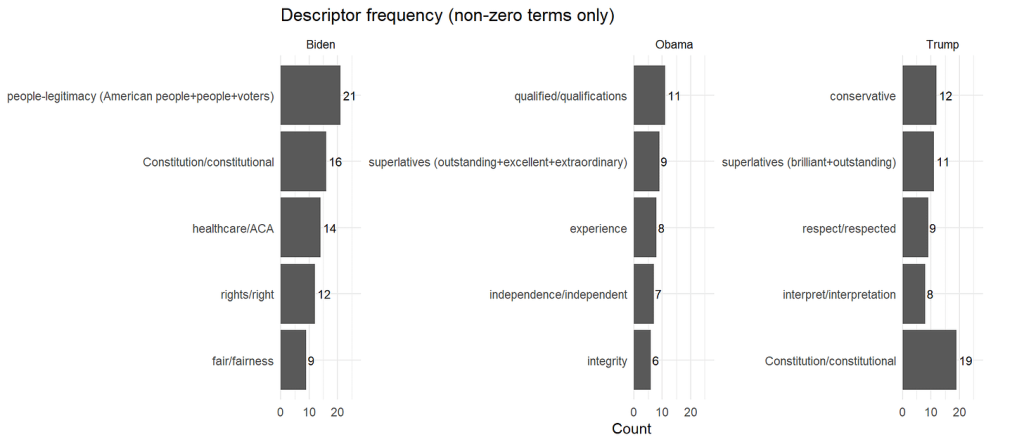
My analysis of nomination-related speeches revealed several distinct vocabularies. Out of all three presidents, Obama focused the most on traditional credentialing language – that is, how qualified the nominee was for the position. Specifically, he frequently used the words “qualified” or “qualifications” (11 times), followed by superlative descriptors such as “outstanding,” “excellent,” and “extraordinary” (nine times combined). Particularly important to Obama was to stress the nominees’ “experience” (eight times), “independence,” (“independence” or “independent” was mentioned in seven times), and “integrity” (six times). In doing so, he focused on competence, consensus, and professional credentials.

Trump’s vocabulary, on the other hand, signaled his expectation of high-caliber nominees that would also hold a particular judicial philosophy. He used “Constitution” or “constitutional” most often (19 times), followed by “conservative” (12 times) and the combined superlatives “brilliant” and “outstanding” (11 times). Additionally, Trump emphasized “respect” or “respected” (nine times) and “interpret” or “interpretation” (eight times).

Biden’s language centered on rights and individual protections. His most frequent terms were the “American people,” “people,” or “voters” (21 times), followed by “constitutional” or “Constitution” (16 times). Biden also focused on specifics more than the other two presidents: He emphasized “healthcare” or the “Affordable Care Act” (14 times, primarily when opposing the nomination of then-Judge Amy Coney Barrett), “rights” or “right” (12 times), and “fair” or “fairness” (nine times). This vocabulary reflected his dual focus on procedural legitimacy and concrete policy stakes.

Thus, whereas Obama focused most on a nominee’s qualifications to be a justice, Biden and Trump were more focused on what the nominee would do as a justice: whether in adhering to an originalist judicial philosophy (in Trump’s case) or advancing democratic legitimacy (in Biden’s case).

Temporal and historical references

The presidents also differed in their use of historical grounding. Obama referenced the founders or framers sparingly (three times) and invoked historical examples moderately (five times, including President Ronald Reagan and Civil War era references). Biden made even fewer references to the founders (two instances) but emphasized Senate confirmation history and electoral precedent (eight examples of historical precedent) – perhaps not surprising given his long tenure in Congress. His rhetoric thus focused primarily on present-day policy implications rather than constitutional history or future projections. Trump most frequently invoked historical authority with references to the founders or framers (six times), made multiple mentions of Reagan (four times), and frequently invoked conservative justices such as Antonin Scalia (seven times). This pattern again aligned with Trump’s overall originalist framing.

Issue linkage

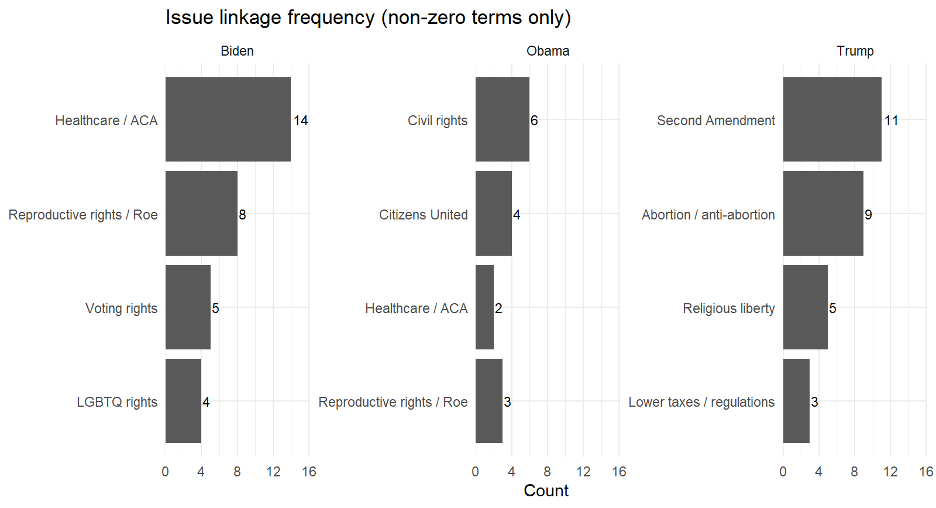
The presidents also varied significantly in connecting court nominations to specific policy outcomes. Obama made moderate policy connections, mentioning Citizens United v. Federal Election Commission (four times), civil rights (six times), reproductive rights (three times), and healthcare or the Affordable Care Act (two times). He typically framed these as the court “standing up for” rights rather than direct policy outcomes.

Biden showed the highest policy linkage – a great deal more than Obama – emphasizing healthcare or the ACA (14 times), reproductive rights or Roe v. Wade (eight times), voting rights (five times), and LGBTQ rights (four times). This explicit connection between judicial appointments and immediate policy consequences distinguished his approach.

Trump again made direct policy commitments tied to originalism, discussing the Second Amendment (11 times), abortion or anti-abortion positions (nine times), religious liberty (five times), and lower taxes or regulations (three times).

Pronoun usage and audience orientation

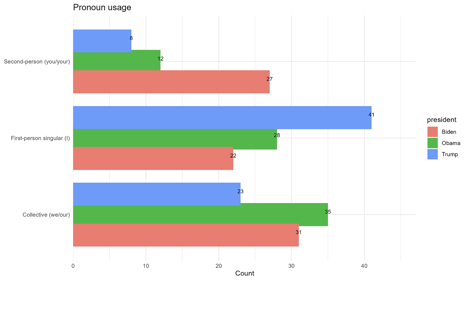
Pronoun patterns also revealed different rhetorical stances. Obama used first-person singular pronouns (28 instances of “I”), collective pronouns (35 instances of “we” or “our”), and second-person pronouns (12 instances of “you” or “your”), seemingly trying to be as inclusive as possible.

Biden employed the first-person singular (22 times), collective (31 times), and notably high second-person usage (27 times). This pattern reflected his emphasis on direct audience engagement, in an attempt to make a direct appeal to the voters.

Trump showed, by far, the highest first-person usage (41 instances of “I”), moderate collective pronouns (23 instances of “we” or “our”), and minimal second person (eight instances of “you” or “your”). This emphasized his personal decision-making authority and power to select the nominee of his choice.

A qualitative lens

Barack Obama: empathy within legal excellence

Obama’s most distinctive rhetorical contribution was articulating a role for empathy in judicial decision-making. In announcing Merrick Garland’s nomination, for example, Obama called him “an extraordinary jurist who is indisputably qualified” with “a spirit of decency, modesty, and even-handedness.” Obama’s March 2016 weekly address emphasized that Garland had “earned the respect of both Democrats and Republicans.”

A 2008 debate statement captured Obama’s judicial philosophy: he sought justices who “have an outstanding judicial record, who have the intellect, and who hopefully have a sense of what real-world folks are going through.” This “real-world” understanding represented a departure from purely technical legal competence. Two decades ago, in Obama’s 2005 Senate speech opposing John Roberts, Obama articulated his famous formulation: “95 percent of cases” follow clear legal rules, but in the crucial “5 percent of hard cases, the constitutional text will not be directly on point” and “the critical ingredient is supplied by what is in the judge’s heart.”

When opposing Samuel Alito’s nomination in a speech a year later, Obama also used politically charged rhetoric: According to him, “[i]n almost every case, [Alito] consistently sides on behalf of the powerful against the powerless; on behalf of a strong government or corporation against upholding Americans’ individual rights.” This framed judicial selection as inherently about whose interests the court would protect, not merely about legal methodology.

Donald Trump: originalism and transparent commitments

While running for office the first time around, perhaps Trump’s most significant innovation was releasing specific lists of potential Supreme Court nominees. In the Oct. 19, 2016, debate, he stated: “I feel that the justices that I am going to appoint – and I’ve named 20 of them – the justices that I’m going to appoint will be pro-life. They will have a conservative bent. They will be protecting the Second Amendment. They are great scholars in all cases, and they’re people of tremendous respect. They will interpret the Constitution the way the founders wanted it interpreted.”

Trump’s July 2018 announcement that he was nominating Brett Kavanaugh to the court emphasized constitutional fidelity: “I chose Justice Gorsuch because I knew that he, just like Justice Scalia, would be a faithful servant of our Constitution.” Trump made note of Kavanaugh’s own judicial philosophy: “A judge must be independent and must interpret the law, not make the law. A judge must interpret statutes as written. And a judge must interpret the Constitution as written, informed by history and tradition and precedent.”

For Barrett in Sept. 2020, Trump used superlative language, calling her “one of our nation’s most brilliant and gifted legal minds” with “unparalleled achievement, towering intellect, sterling credentials, and unyielding loyalty to the Constitution.” He also detailed her academic achievements, noting that she had “graduated first in her class” and received “the law school’s award for the best record of scholarship and achievement.” And, as with his other nominees, Trump expressed that she would “decide cases based on the text of the Constitution as written.”

Trump’s rhetoric to interpret the law as written contrasted significantly with Obama’s reference to “what is in the judge’s heart.”

Joe Biden: democratic process and rights protection

Biden’s rhetoric centered heavily on what potential justices would decide and the legitimacy of the process in naming them. In September of 2020 he addressed this directly with respect to Barrett’s nomination, contending that she had “a written track record of disagreeing with the U.S. Supreme Court’s decision upholding the Affordable Care Act.” The Sept. 29, 2020, debate featured his repeated refrain: “The American people have a right to have a say in who the Supreme Court nominee is and that say occurs when they vote for United States Senators and when they vote for the President.”

Biden further called Barrett’s rushed confirmation “an abuse of power” and emphasized that it violated Senate precedent. His Oct. 26, 2020, statement characterized the confirmation as occurring “in the middle of an ongoing election.” (Although, notably, in the Sept. 29 debate, Biden said of Barrett personally: “I’m not opposed to the justice, she seems like a very fine person.”)

When announcing the nomination of Ketanji Brown Jackson to the court in Feb. 2022, Biden focused on her “exceptional credentials, unimpeachable character, and unwavering dedication to the rule of law.” He highlighted her “broad experience” across multiple legal roles and her “bipartisan” confirmation history. And Biden had previously made the historic significance of such a justice explicit (as described more below): “As everyone knows – I have made it clear that my first choice for the Supreme Court will make history as the first African American woman Justice.”

Comparing presidents

So what are the takeaways? I think this is best seen in three areas: the role of constitutional philosophy, the president’s political strategies and base mobilization, and the importance of identity and demographic framing.

The role of constitutional philosophy

Obama articulated living constitutionalism implicitly through an emphasis on judges understanding societal context and protecting vulnerable populations. His language suggested that constitutional meaning evolves through applications to new circumstances. The “percent of hard cases” formulation acknowledged that legal texts sometimes require judges to exercise judgment informed by their own values and their decisions’ real-world impacts.

Trump explicitly championed not outcomes but methodology, and specifically originalism, repeatedly stating judges should “interpret the Constitution the way the founders wanted it interpreted.” His campaign materials emphasized selecting judges who would “uphold the principles of the U.S. Constitution” as understood in originalist terms.

Biden focused less on constitutional theory than Obama or Trump and more on institutional legitimacy and concrete rights. His emphasis on process – ”the people should speak”—and specific policy outcomes (healthcare, reproductive rights) suggested a pragmatic approach that measured judicial appointments by their likely impact on Americans’ lives rather than abstract interpretive methodology.

Political strategy and base mobilization

Obama’s strategy emphasized consensus and competence to appeal to both moderates and legal elites, reflected in his emphasis on nominees’ qualifications to the Supreme Court. Garland’s selection – a moderate once praised by Republicans – exemplified attempted bipartisan bridge-building (though it ultimately failed to accomplish this).

Trump took a very different approach, explicitly mobilizing (potentially skeptical) conservative voters through transparent commitments on specific issues (abortion, guns, religious liberty). The nominee lists provided unprecedented accountability and clarity. His campaign emphasized that judicial appointments would be reserved for originalists and made the court’s composition a central campaign issue.

Biden adopted a dual strategy, trying to carve out a middle way between Obama and Trump: He opposed Republican nominees on procedural grounds (timing, process) while emphasizing concrete rights threatened by conservative court majorities. For example, Biden’s healthcare focus in opposing Barrett directly mobilized voters concerned about the ACA. And for his own nominee, Jackson, Biden combined historic representation with broad credentials to try and energize the Democratic base.

Identity and representation framing

Which brings us to the final category: identity (and qualifications). Obama explicitly acknowledged such considerations when nominating Garland, stating in 2016: “I appointed a Latino woman and another woman right before that, so, yeah, he’s a white guy, but he’s a really outstanding jurist.”

Trump emphasized merit (like Obama) but also noted demographic milestones. For Barrett, he highlighted that she would be “the first mother of school-aged children ever to serve on the U.S. Supreme Court.” And while much of Trump’s rhetoric focused on judicial philosophy and credentials rather than identity, even he acknowledged, in 2020, that Justice Ruth Bader Ginsburg’s replacement would “most likely” be a woman.

Finally, Biden made historic representation central and explicit – even more so than Obama. His campaign promise to nominate the first Black woman justice became a defining commitment. When announcing Jackson, he celebrated both her historic significance and her extensive qualifications, presenting these as mutually reinforcing rather than in tension.

Conclusion

Quantitative and qualitative analysis reveals three distinct rhetorical approaches to Supreme Court nominations. Obama’s language emphasized what I have called empathy within excellence, focusing on both his nominees’ qualifications and their ability to understand the real-world impacts of their potential decisions. His vocabulary centered on merit, experience, and independence. Biden’s rhetoric prioritized democratic legitimacy and rights protection. Trump’s language explicitly championed originalism and conservatism, while providing unprecedented transparency into his potential choices for the court.

These patterns reflect fundamentally different visions of the court’s role. Obama’s “5 percent of hard cases” acknowledges discretion and the need for empathy in the application of legal principles. Biden’s emphasis on “the people should speak” focuses on democratic input and immediate policy consequences. And Trump’s call to “interpret the Constitution the way the founders wanted” appeals to originalist theory and the conservative legal movement. As the court’s composition continues shaping U.S. law and society – and as talk intensifies concerning a future opening on the court – presidential rhetoric around its nominees remains a crucial window into competing constitutional visions and the evolving relationship between law, politics, and democratic governance.

The post Presidential rhetoric and Supreme Court nominees appeared first on SCOTUSblog.

https://www.scotusblog.com/2026/01/presidential-rhetoric-and-supreme-court-nominees/ January 14, 2026 at 10:17AM

SCOTUStoday for Wednesday, January 14

Welcome to another opinion day at the Supreme Court. Please join our live blog, which begins at 9:30 a.m. EST, for any opinion announcements.

SCOTUS Quick Hits

  • On Tuesday, the justices heard arguments in Little v. Hecox and West Virginia v. B.P.J., on laws barring transgender athletes from participating on women’s and girls’ sports teams. SCOTUSblog hosted a live blog during the arguments, and Amy analyzed what transpired.
  • The court has indicated that it may announce opinions this morning at 10 a.m. EST. As noted above, SCOTUSblog will be live blogging any opinion announcements beginning at 9:30.
  • After any opinion announcement(s), the justices will hear argument in Galette v. New Jersey Transit Corporation, on whether New Jersey Transit Corporation is an “arm of the state” that can invoke sovereign immunity to prevent suits against it in other states.
  • The court has been asked to vacate a stay from the U.S. Court of Appeals for the 9th Circuit that paused a ruling requiring educators to notify parents if their child changes the name or pronouns they’re using in school. A response to this request is due by 4 p.m. EST on Wednesday, Jan. 21.

Morning Reads

  • Supreme Court seems likely to allow state bans of trans athletes in school sports (Associated Press) — The Associated Press on Tuesday shared several details of what the scene was like inside and outside the courtroom as the justices heard arguments on laws banning transgender athletes from women’s and girls’ sports in schools. Reporters noted that U.S. Solicitor General D. John Sauer was in attendance and that competing demonstrations outside the Supreme Court Building made it difficult to hear the lawyers for each side as they spoke with the press after arguments.
  • Supreme Court fills out docket for term: Petitions to watch (Zach Schonfeld, The Hill) — The spotlight on this Friday’s private conference between the justices will be brighter than normal because the court is expected to finish filling out its oral argument docket for the 2025-26 term in the near future, according to The Hill. Among the petitions up for consideration on Friday are “ones that implicate parental rights, the energy industry, guns, Roundup weedkiller and employer retirement plans.”
  • Prediction market traders bet against Trump’s tariffs as Supreme Court ruling looms (Amanda Macias, Fox Business) — As the country awaits the court’s ruling on President Donald Trump’s tariffs, prediction platforms like Kalshi and Polymarket continue to take bets on how the case will turn out. Most traders believe the court will strike down the tariffs, according to Fox Business. “Traders on Kalshi now give a nearly 32% chance that the Supreme Court will side with Trump’s tariff plan, down 14 points after oral arguments in November signaled potential skepticism from the justices. … Polymarket mirrors that sentiment, with odds also at 28%, down 9 points over the same period of time.”
  • Man to plead guilty to hacking US Supreme Court filing system (Lorenzo Franceschi-Bicchierai, TechCrunch) — On Friday, Nicholas Moore, 24, of Springfield, Tennessee, “is expected to plead guilty to hacking the U.S. Supreme Court’s electronic document filing system dozens of times over several months,” according to TechCrunch. “Prosecutors say between August and October 2023,” Moore “‘intentionally accessed a computer without authorization on 25 different days and thereby obtained information from a protected computer,’ according to a court document.”
  • US Supreme Court rejects state petition to take up fight over Alaska subsistence (Alex DeMarban, Anchorage Daily News) — Monday’s order list revealed that the justices will not “review a lower court’s decision in a case involving subsistence fishing in Alaska, a decision that keeps in place a unique federal protection viewed as critical by Alaska Natives,” according to the Anchorage Daily News. The state of Alaska had asked the Supreme Court to address the federal government’s control over “fishing on a 180-mile portion of the Kuskokwim River in Southwest Alaska, as it winds through the Yukon Delta National Wildlife Refuge,” and the preference the federal government gives to hunters and fishermen from rural areas of the state. Alaska contended that the current set-up interferes with its “ability to manage its lands and resources comprehensively.”
  • How the Supreme Court Broke Congress (Duncan Hosie, The Atlantic)(Paywall) — In a column for The Atlantic, Duncan Hosie described Congress’ decline in recent decades and the Supreme Court’s ascent over the same period. These changes, according to Hosie, “are fundamentally reshaping the structure and functioning of the American government,” and they will be difficult to reverse, because the court’s work has “reinforc[ed] Congress’s sclerosis,” in part by “preemptively removing entire policy domains,” including labor-organizing protections and restrictions on gun ownership, “from democratic deliberation.”

A Closer Look: Coverage of the Arguments on Transgender Athletes

Yesterday’s oral arguments in Little v. Hecox and West Virginia v. B.P.J. were covered live by several news outlets and summarized afterward by even more. As we’ve done after arguments in other closely watched cases, we compiled a sampling of headlines used on stories about the discussion, which we believe give us a sense of how the day went for all parties.

Reuters: US Supreme Court conservatives lean toward allowing transgender sports bans

The Wall Street Journal: Supreme Court Appears Likely to Uphold Transgender Sports Bans

The Washington Post: Supreme Court appears skeptical of challenges to bans on trans athletes

NBC News: Supreme Court leans toward backing state restrictions on transgender student-athletes

NPR: Supreme Court appears likely to uphold state bans on transgender athletes

Bloomberg: Supreme Court Suggests Support for Laws Curbing Trans Athletes

The Washington Times: Supreme Court poised to side with states barring trans athletes from girls’ sports

The Hill: Supreme Court seems receptive to transgender athlete bans

Vox: The Supreme Court seems poised to deliver another blow to trans rights

SCOTUS Quote

MS. HARTNETT: “You heard my friend on the other side talk about, not about cross-dressing or other laws. They didn’t have any response to our point because there isn’t one, that transgender people were categorically excluded from immigration to this country under an overall umbrella of being a psychopath. That was the way –that was the actual decision of this Court in the Boutilier case. It was interpreting language of Congress that determined that when Congress used the term ‘psychopathic personality’ to exclude people, they meant to include homosexuals and other sex perverts. And then that –­”

JUSTICE GORSUCH: “Perhaps not our finest hour.”

MS. HARTNETT: “Well, it’s not your thought, but I think that –­”

JUSTICE GORSUCH: “Thank you for that.”

Little v. Hecox

On Site

Argument Analysis

The U.S. Supreme Court is shown on April 25, 2022 in Washington, DC.

Supreme Court appears likely to uphold transgender athlete bans

After nearly three-and-a-half hours of arguments in a pair of cases from Idaho and West Virginia on laws barring transgender athletes from participating in girls’ and women’s sports, a majority of the justices appeared to agree with the states that the laws can remain in place, even if it was not clear how broadly their ruling might sweep.

Opinion Analysis

supremecourt-2

Bare court majority sides with federal inmate on questions of habeas procedure

In a 5-4 decision released on Friday, the Supreme Court decided two complicated questions concerning federal habeas review. Richard Cooke analyzed the ruling in Bowe v. United States for SCOTUSblog.

The post SCOTUStoday for Wednesday, January 14 appeared first on SCOTUSblog.

https://www.scotusblog.com/2026/01/scotustoday-for-wednesday-january-14/ January 14, 2026 at 08:00AM

Your bacon is a scam

video:Why Medieval Meat Lasted 3+ Years While Your Bacon Rots In 5 Days You bought it six days ago but it's already turning grey at the ...